Active Learning
What is it?
Why use it?
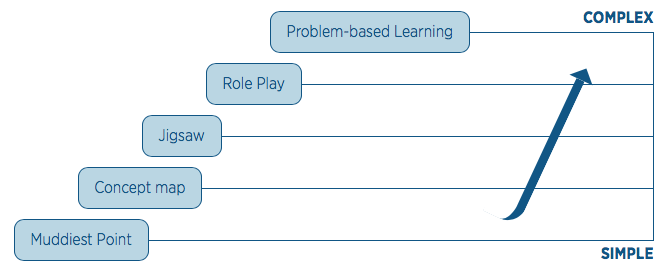
A useful way of categorising activities along this spectrum is to think about how activities can be used to improve levels of content knowledge in a domain through to thinking about how this knowledge can be extended or applied in different contexts. When learning activities are thought about like this, it becomes easier to decide which activities are appropriate for your students in their learning journeys. Hattie and Yates’ (2013) interpretation of the SOLO taxonomy provides a useful starting point for categorising learning activities according to their function in your learning design. The active learning diagram (above) illustrates this idea because it is likely that if you are implementing problem-based learning, for example, students will be required to identify ideas, relate them and extend them at identified points during the learning process. Active learning, therefore, should not be seen as an additive series of learning stages or phases but as a collection of activities that can be combined to promote your students as active participants in the learning process.
Active learning is not just an approach or set of teaching and learning strategies. It has deep roots in the constructivist and socio-cultural traditions. If you are interested in exploring the theoretical roots of active learning in greater depth see Robertson (2018) and Hattie & Yates (2013). Hattie & Yates (2013) is available as an online book through the University’s library.
References
Hattie, J., & Yates, G. C. R. (2013). Visible Learning and the Science of How We Learn (1st ed.). Routledge. https://doi.org/10.4324/9781315885025 ( eBook available from Western Sydney University Library )
Robertson, L. (2018). Toward an Epistemology of Active Learning in Higher Education and Its Promise. In Active Learning Strategies in Higher Education: Teaching for Leadership, Innovation, and Creativity (pp. 17–44). Emerald Publishing Limited.