
Simulation
What is it?
Simulation is a design strategy that aims to expose students to authentic learning events or processes in a safe environment.
Why use it?
There are various reasons why you might consider using simulations and these are outlined below (taken from Dalhousie University’s resource on simulation). In a recent meta-analysis of the use of simulation in higher-education (Chernikova et. al, 2020), simulation was found to be particularly useful in the acquisition of skills.
-
Skills Building
- Steadman, R. H., Coates, W. C., Huang, Y. M., Matevosian, R. R., Larmon, B., McCullough, L., & Ariel, D. (2006). Simulation-based training is superior to problem-based learning for the acquisition of critical assessment and management skills. Critical Care Medicine , 34(1), 151-157.
- Asal, V., & Blake, E. (2006). Creating Simulations for Political Science Education. Journal of Political Science Education , 2(1), 1-18.
- Chernikova O, Heitzmann N, Stadler M, Holzberger D, Seidel T, Fischer F. Simulation-Based Learning in Higher Education: A Meta-Analysis. Review of Educational Research. 2020;90(4):499-541. doi:10.3102/0034654320933544
-
Knowledge Acquisition
- Haukedal, T. A., Reierson, I. Å., Hedeman, H., & Bjørk, I. T. (2018). The Impact of a New Pedagogical Intervention on Nursing Students’ Knowledge Acquisition in Simulation-Based Learning: A Quasi-Experimental Study. Nursing research and practice , 2018 , 7437386. https://doi.org/10.1155/2018/7437386
-
Student Engagement
- (2020) Students’ engagement and learning experiences using virtual patient simulation in a computer supported collaborative learning environment, Innovations in Education and Teaching International, 57:1, 50-61, DOI: 10.1080/14703297.2018.1541188
- (2017) Does Reacting to the Past Increase Student Engagement? An Empirical Evaluation of the Use of Historical Simulations in Teaching Political Theory, Journal of Political Science Education, 13:1, 46-61, DOI: 10.1080/15512169.2016.1175948
-
Real-world Application
- Riddell J. Putting authentic learning on trial: Using trials as a pedagogical model for teaching in the humanities. Arts and Humanities in Higher Education. 2018;17(4):410-432. doi:10.1177/1474022217722510
How do I do it?
Dalhousie University has a very useful resource that outlines the steps that can help you design your simulation pedagogy (see the ‘Simulation Life Cycle’ below).
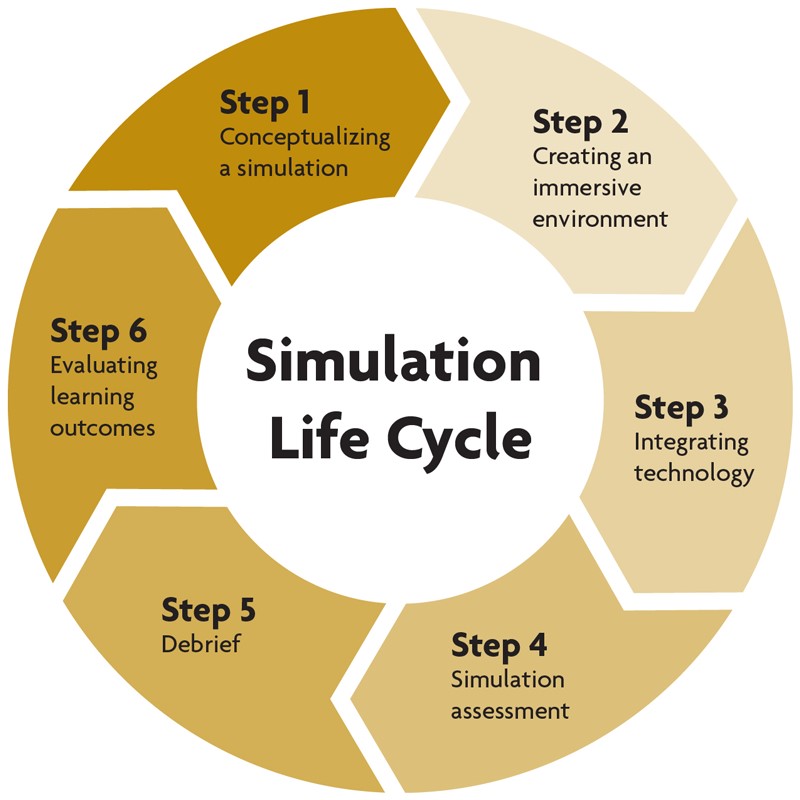
From https://www.dal.ca/dept/clt/simulation.html
These resources outlines the strategies for addressing the multiple phases in the development of a simulation.
- How do I create an immersive environment?
- How do I choose the appropriate technology?
- How do I assess my students?
- How do I encourage student reflection?
- How do I evaluate my simulation?
As you consider introducing simulation pedagogy into your classroom the following considerations might have an impact on your design decisions.
-
Timeframe
- Depending on your objectives some simulations are likely to be able to conducted during a classroom session (e.g. debate) but some will require longer periods to complete such as immersive role plays which involve teams and individuals taking on roles.
-
Size of class
- It is easier to conduct simulations that can be completed in a short time with smaller groups whereas character role plays are more likely to work more effectively in larger groups which can be broken up into smaller ‘role’ groups.
-
Student cohort
- Consider how much scaffolding you will provide your students. 1st or 2nd year students are likely to need more scaffolding to complete and participate in a simulation compared to more advanced students. For example, how effective will the simulation be if students lack foundational knowledge?
Extra Resources
Introduction to modelling and simulation
Simulation in clinical teaching and learning
Stat Trek – simulation of random events
AcqNotes – modelling and simulation
Harvard School of Business guide to online simulation
References
Chernikova O, Heitzmann N, Stadler M, Holzberger D, Seidel T, Fischer F. Simulation-Based Learning in Higher Education: A Meta-Analysis. Review of Educational Research . 2020;90(4):499-541. doi: 10.3102/0034654320933544
