
Introduction
In the educational context, the wide scale collection and use of data has been relatively slow despite well-established online systems, such as the learning management system (LMS), being used across institutions for many years (Joksimovic et al., 2019). It was only in 2011 when the first International Conference on Learning Analytics and Knowledge (LAK’11) was held that the widely cited definition of learning analytics was born. It defines learning analytics as the:
“ measurement, collection, analysis and reporting of data about learners and their contexts, for purposes of understanding and optimizing learning and the environments in which it occurs ”
(Siemens et al., 2011)
Since this conference, the field of learning analytics has significantly grown and interest is much more widespread with increased funding for research, publications and commercial technologies (Joksimovic et al., 2019).
Learning analytics, as a field, draws on a number of disciplines including education, learning science, neuroscience, computer science, data science, human-computer interaction and business intelligence (Siemens, 2013). Reimann (2016) provides some points of difference of learning analytics from other similar fields, including the focus on quantitative data, the large data sets, the fine granularity of data and the longitudinal collection of data. Furthermore, Siemens (2013) suggests that learning analytics is more focused on sensemaking and action. Across the literature there is a common consensus that learning analytics provides actionable insights (For example: Colvin et al., 2016; Gasevic et al., 2016; Lui et al., 2017). An actionable insight is said to be a “data-informed decision-making perspective” (Jorno & Gynther, 2018, p. 210) where the educator is responsible for interpreting the data and deciding on an appropriate course of action.
Consolidated Model
Despite there being some consensus in the literature around the definition and purpose of learning analytics, there are a number of models that have been proposed. Each model provides a slightly different perspective and focus on exactly what the definition of learning analytics is and what learning analytics aims to achieve.
The consolidated model of learning analytics strongly recognises the role of learning analytics in the educational context and the breadth of disciplines that it draws on. It asserts that “the foundational principles of learning analytics can be grouped around three mutually connected dimensions – theory, design and data science” (Gasevic et al., 2017, p. 66).
Figure 1
The Consolidated Model of learning analytics
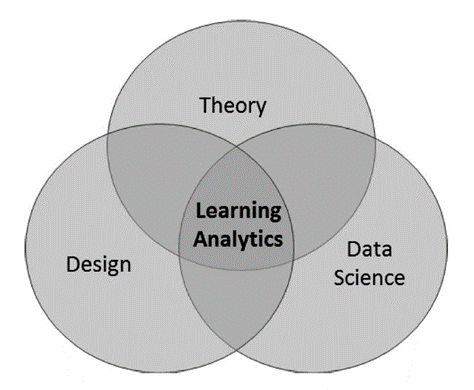
Note . The Venn diagram of the Consolidated Model of learning analytics was obtained from Gasevic et al. (2017).
In their paper, “ Piecing the learning analytics puzzle: a consolidated model of a field of research and practice ”, Gasevic et al. (2017) describe the three dimensions of the consolidated model for learning analytics in some detail.
Firstly, Gasevic et al. (2017) assert that theory plays a vital role in both the research and practice of learning analytics. Sources of theory that are particularly key involve human learning, teaching and education, but also include design, data science, psychology, sociology, information science and others. Theory in learning analytics informs the choice of questions, hypothesis testing, interpretation of data, explaining anomalies and inconsistencies in data, making meaningful connections with learning constructs, actions in response to the data, design of tools and design of learning analytics environments.
Secondly, Gasevic et al. (2017) suggest that the design dimension has three main components: interaction and visualisation design, learning design and study design.
- Interaction and visualisation design is concerned with the design and development of interactive visualisations that are grounded in learning theory and aim to promote and evaluate particular learning mechanisms.
- Learning design is the deliberate sequence of activities and learning material that provides the conditions for student learning. Learning analytics must be able to account for the effects of learning design, provide relevant data and analysis and result in actionable insights that can inform this practice.
- Data collected for learners often involves large amounts of data which are collected longitudinally in an authentic learning setting. This data must be considered using careful study design, which is deeply associated with theoretical framing, data collection, analysis, methods and interpretation.
Finally, the process, methods and techniques of data science are key aspects of learning analytics as suggested by the given learning analytics definition, which involves the measurement, collection, analysis and reporting of data. It must be noted that the data science process in learning analytics has a deep connection with theory and design. The data science techniques, methods and models for analysis must be orientated and informed by the theoretical foundations of learning.
Current Trends
Learning analytics has broad applications in teaching and learning, however, there are a number of current trends that can be observed in the field. The following are some of the most common trends in learning analytics research and practice:
Learning analytics for predicting student retention and success
Initial learning analytics research orientated around developing models for predicting student retention and academic performance (Gasevic et al., 2015). The data that is often drawn on includes demographic data from the student management system, LMS engagement and past academic performance. Using this data, the model identifies individual students who are considered “at-risk”. An intervention is put in place from at-risk students where most commonly students are contacted and provided support services to help them succeed. Student performance is often modelled which seeks to correlate particular learner demographics, interactions and participation in activities to predict how well a student will perform.
Learning analytics for understanding student interactions
Investigating student social interactions with peers and teachers through Social Network Analysis (SNA) is a key aspect of learning analytics research (Dawson et al., 2014, as cited in Joksimovic et al., 2019). SNA can be applied to learner interactions within platforms such as the LMS and social media. Some examples of the insights SNA provides includes the ability to understand the student community, how student and teachers interact, their socialisation and learning outcomes.
Learning analytics for understanding discourse
Discourse analysis in learning analytics is used to explore discussion within online communications such as discussion boards, chat rooms and social media (Joksimović, 2019). It most commonly uses natural language processing techniques of unstructured, textual data to develop quantitative measures which are then processed using machine learning algorithms (Joksimović, 2019).
Future Development
The future of learning analytics has been influenced by our evolving knowledge and understanding of learning analytics, technological advancements in computing power, machine learning and AI.
Learning analytics embedded into the learning process
The output and reporting of learning analytics needs to be better embedded into the student learning process to support student learning. Matcha et al. (2020) identifies the lack of support to develop metacognitive skills in students and that learning analytics should be more strongly founded on educational theory. Verbert et al. (2020) proposes that there should be more availability of data for students to reflect on and that the learning analytics should offer up actionable insights that students could take to improve their learning. Furthermore, the learning analytics should respond and react differently to different students at different points during the course of the semester.
Learning analytics grounded in educational theory
The consolidated learning analytics model has a strong focus on the educational underpinning of the data, interpretation, and use of student data. However, the lack of theory in learning analytics research and practice has been a criticism (Joksimovic et al., 2019). Most often, simple proxy measures of learning are used to understand and measure student learning. However, to understand and develop meaningful measures of learning a strong grounding in theory must be associated. Therefore, alignment to learning theory will provide much richer insights for end-users.
Learning analytics using multimodal data
One focus of learning analytics research has been exploring emotional data. Literature suggests that when students participate in learning activities that they exhibit an emotional response (D’Mello, 2017, as cited in Joksimovic et al., 2019). Most of this data is captured in laboratory conditions and for the most part has been collected using judgement protocols or self-reporting. Emerging research has shown that emotions can be captured using multimodal learning analytics using data from body signals, classroom observations or coding recorded sessions (D’Mello, 2017, as cited in Joksimovic et al., 2019)
Learning analytics beyond one-way communication
There are some conversations around how to move learning analytics dashboards and reporting beyond one-way communication sources towards conversational systems where humans and dashboards can work together. Verbert et al. (2020) suggests that an underlying principle of this idea is that users must trust the reporting and there should be more transparency around how the underlying data is generated and measured. Furthermore, end users will be able to modify the dashboard by being able to change the input data, adjust the report parameters and make changes to the underlying data model.
Conclusion
As we reflect on learning analytics in the higher education sector, we have seen that it is a relatively new field that is continuing to develop. However, there has been a large body of research over the last decade which highlights its necessity in education and demonstrates how we can use learning analytics to improve our teaching and learning. Models of learning analytics, such as the consolidated learning analytics model, emphasise our need to contextualise our data and analysis in the learning theory, and the learning design, of the subject that the data has been collected from. From this position, our data can provide actionable insights where we can make informed decisions to improve our teaching and learning.
References
Colvin, C., Rogers, T., Wade, A., Dawson, S., Gašević, D., Buckingham Shum, S., Nelson, K., Alexander, S., Lockyer, L., Kennedy, G., Corrin, L., & Fisher, J. (2016). Student retention and learning analytics: A snapshot of Australian practices and a framework for advancement. Canberra, ACT: Australian Government Office for Learning and Teaching. Retrieved from https://opus.lib.uts.edu.au/handle/10453/117173
Dawson, S., Gašević, D., Siemens, G., & Joksimovic, S. (2014). Current state and future trends: A citation network analysis of the learning analytics field. In Proceedings of the Fourth International Conference on Learning Analytics and Knowledge (pp. 231–240). New York, NY, USA: ACM. https://doi.org/10.1145/2567574.2567585
D’Mello, S. (2017). Emotional Learning Analytics. In Lang, C., Siemens, G., Wise, A.F., & Gaševic, D. (Eds.), The Handbook of Learning Analytics (1st ed., pp. 115–127). Alberta, Canada: Society for Learning Analytics Research (SoLAR). Retrieved from http://solaresearch.org/hla-17/hla17-chapter1
Gašević, D., Dawson, S., & Siemens, G. (2015). Let’s not forget: Learning analytics are about learning. TechTrends , 59 (1), 64–71. https://doi.org/10.1007/s11528-014-0822-x
Gašević, D., Dawson, S.,Pardo, A. (2016). How do we start? State and directions of learning analytics adoption. Oslo, Norway: International Council for Open and Distance Education
Gašević, Kovanović, V., & Joksimović, S. (2017). Piecing the learning analytics puzzle: a consolidated model of a field of research and practice. Learning (Abingdon (England)) , 3 (1), 63–78. https://doi.org/10.1080/23735082.2017.1286142
Joksimović, S., Kovanovic, V., & Dawson, S.. (2019). The journey of learning analytics. Higher Education Research and Development, 6 (July 2019), 37–63.
Jørnø, & Gynther, K. (2018). What Constitutes an “Actionable Insight” in Learning Analytics? Journal of Learning Analytics , 5 (3). https://doi.org/10.18608/jla.2018.53.13
Liu, D. Y. T., Bartimote-Aufflick, K., Pardo, A., & Bridgeman, A. J. (2017). Data-driven personalization of student learning support in higher education. In A. Peña-Ayala (Ed.), Learning analytics: Fundaments, applications, and trends: A view of the current state of the art to enhance e-learning (pp. 143–170). Cham, Switzerland: Springer.http://dx.doi.org/10.1007/978-3-319-52977-6_5
Matcha, W., Uzir, N. A., Gasevic, D., & Pardo, A. (2020). A Systematic Review of Empirical Studies on Learning Analytics Dashboards: A Self-Regulated Learning Perspective. IEEE Transactions on Learning Technologies , 13 (2), 226–245. https://doi.org/10.1109/TLT.2019.2916802
Reimann, P. (2016). Connecting learning analytics with learning research: the role of design-based research. Learning: Research and Practice , 2 (2), 130–142. https://doi.org/10.1080/23735082.2016.1210198
Siemens, G., Long, P., Gašević, D., & Conole, G. (2011). Call for Papers, 1st International Conference Learning Analytics & Knowledge (LAK 2011). Retrieved from https://tekri.athabascau.ca/analytics/call-papers
Siemens, G. (2013). Learning Analytics: The Emergence of a Discipline. American Behavioral Scientist , 57 (10), 1380–1400. https://doi.org/10.1177/0002764213498851
Verbert, K., Ochoa, X., Croon, R.D., Dourado, R.A., & Laet, T.D. (2020). Learning analytics dashboards: the past, the present and the future. Proceedings of the Tenth International Conference on Learning Analytics & Knowledge .
|
Daniel Purdy FHEA is a Learning Science Analyst at Western Sydney University and an editor of the university’s Online Engagement and Teaching Hub.
Please cite as Purdy, D. (2023). What are the foundations of Learning Analytics?. Western Sydney University Online Engagement and Teaching Hub. https://lf.westernsydney.edu.au/engage/theory/what-are-the-foundations-of-learning-analytics |
