
Introduction
Universal Design for Learning (UDL) is a set of principles that aims to guide the way we approach teaching and learning, including the development of learning outcomes, content, and assessments. Based on the principles of inclusivity, UDL seeks to improve the learning experience for all students, regardless of their individual abilities and backgrounds. UDL recognises the inherent variability in the learning process, embracing the idea that there is no standard learner. By providing multiple means of representation, engagement, and expression, UDL promotes the design of flexible and inclusive instructional methods that accommodate the diverse ways in which students learn. This article explores the history and core principles of UDL, its impact on educational practices, and the potential UDL holds for creating more equitable and effective learning environments.
Brief History of UDL
UDL originates from the architectural concept of universal design conceptualised by architect, Ronald Mace, and scholars from the Center for Universal Design at North Carolina State University. The central idea of universal design is to design environments and products for as many people as possible or in other words, design that benefits everyone. For example, sidewalk curb cuts were designed for people with mobility issues, but they also benefit parents with strollers, travellers with rolling suitcases, and skaters. Universal design gained momentum in the 1990s with the occurrence of the Americans with Disabilities Act, which involved the massive undertaking of retrofitting existing structures to grant equal access to individuals with disabilities within public spaces. Universal Design, therefore, strives to create solutions that work for everyone, rather than retrofitting accommodations later. Essentially, universal design seeks to eliminate barriers and promote inclusivity by considering the diverse needs and preferences of a wide range of users from the outset of the design process (Matthews, Cavanaugh and Wilson, 2023).
Researchers and educators also began to recognise the limitations of traditional one-size-fits-all instructional approaches. Its adaptation to education, marked by the pioneering work of educators and researchers, Dr. David Rose and Dr. Anne Meyer from the Harvard Graduate School of Education, officially coining the term, “Universal Design for Learning”. The UDL framework proposed by Rose and Meyer aims to apply principles of universal design from architecture to education, emphasising the creation of flexible instructional materials and methods that cater to a wide range of learners. Three key UDL principles were proposed: multiple means of representation, engagement, and expression. Over the years, UDL gained traction as a comprehensive framework for educational design, guiding educators in developing curricula and instructional practices that acknowledge and embrace the diversity of learners, fostering a more inclusive and equitable learning environment (Nelson, 2014).
Key UDL Principles
The UDL framework (Rose, Meyer, and Gordon, 2014) outlines overarching categories in planning and designing for learning. Each one addresses key aspects of the learning process with the aim of providing flexibility and options for diverse learners:
- Multiple Means of Representation (Content) : This principle focuses on presenting information and content in various ways to cater to the diverse ways individuals perceive and comprehend information. It involves offering information through different formats, such as text, images, audio, video, and interactive media. By providing multiple means of representation, educators ensure that learners can access content in a way that aligns with their needs, and abilities. For example, a science lesson might include not only written text explanations, but also, diagrams and videos to accommodate different learning needs.
- Multiple Means of Engagement (Learning Process) : This principle centres on providing diverse and flexible ways for students to engage with learning materials and participate in the learning process. It emphasises the importance of tapping into students’ interests, motivations, and backgrounds. By incorporating varied methods, such as interactive activities, discussions, and real-world applications, educators can enhance student engagement and maintain interest in the learning experience. This principle recognises that learners differ in their levels of motivation and interest, and providing multiple avenues for engagement helps address these variations.
- Multiple Means of Action and Expression (Assessment) : The third principle of UDL focuses on allowing students to demonstrate their understanding and knowledge in various ways. Instead of relying solely on traditional assessments like written exams, educators should offer a range of options for students to express themselves. This could include written assignments, oral presentations, projects, multimedia creations, or other forms of assessment. By providing multiple means of action and expression, UDL acknowledges that individuals have different strengths and challenges when it comes to demonstrating what they have learned, and it promotes fair and inclusive assessment practices.
In summary, the three principles of UDL work together to create a learning environment that is flexible, responsive, and accessible to the diverse needs of all learners, promoting equity and inclusion in education (Meyer et al., 2014).
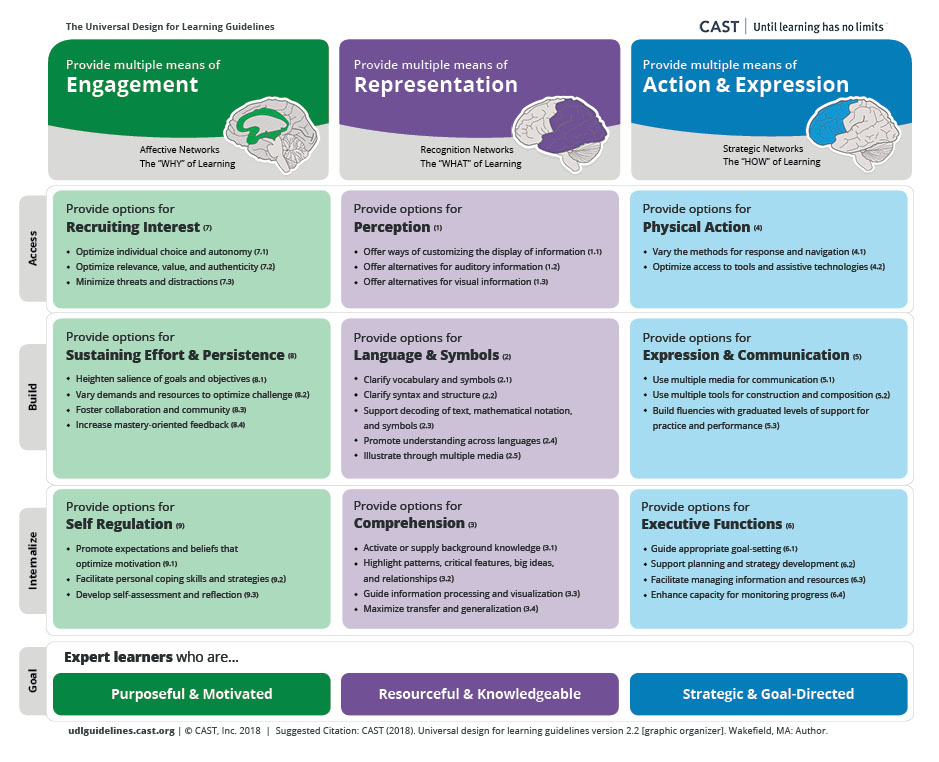
Download CAST’s UDL Guidelines (PDF, 401Kb)
UDL in Higher Education
According to the Australian Government Department of Education, Skills and Employment (DESE), the number of students with disabilities enrolled in universities across Australia has increased over the years from 4.2% in 2009 to 7.2% in 2019 (2020). A broad definition of disability can be found in the Disability Discrimination Act (1992), that includes, physical, sensory, mental, and intellectual disabilities. While there seem to be support services and adjustments available at universities for students with disabilities, there is an onus on students to disclose their condition to be eligible for these provisions. Additionally, teaching staff are unsure on how to provide adjustments while maintaining course integrity (Cumming and Rose, 2021). A study conducted by Cunninghame, Costello and Trinidad (2016) around the experiences of students with disclosed disabilities at Australian universities found that these students had lower success and retention rates than non-disabled students. The implementation of UDL approaches in learning and teaching practice are thought to provide students with and without disabilities opportunities to engage within their learning environments while having their diverse needs recognised and met (Singleton et al., 2019). In Australia, the higher education sector has been increasingly recognising the significance of designing inclusive learning environments. The University of New South Wales (UNSW) provides guidelines, case studies, webinars and other resources to assist teaching staff in the application of UDL in practice, emphasising the importance of flexibility in teaching to support variability in learning. Similarly, Sydney University offer teaching staff opportunities to share and collaborate on their approaches to UDL.
The theory and practice of UDL are also supported by a wide body of literature and research. In 2021, Cumming and Rose reviewed current literature on UDL as an accessibility tool in higher education, and their findings indicated positive student experiences with the implementation of UDL in their learning environments, for learners with and without disabilities. The studies reported high satisfaction among students, particularly in reference to the added value of UDL in clarifying course content and increasing their feelings of engagement and capacity to participate in the learning. Cumming and Rose (2021) also highlighted that among the studies reviewed, students also valued the affordances of technology within their learning environment in enabling multiple means of representation, engagement, and expressions, referring to the core principles of the UDL model.
While research suggests that UDL can enhance student engagement, improve learning outcomes, and reduce barriers for learners with and without disabilities (Ayala & Christie, 2011; Anderson et al., 2018), the successful implementation of UDL requires a strategic and comprehensive approach, which may present challenges in practice. One critical aspect reported by Cumming and Rose (2021) is faculty development and training. For instance, research by Kennette and Wilson (2019) emphasises the importance of professional development for educators to effectively implement UDL. Teaching staff need support and resources to redesign courses and assessments to align with UDL principles. These programs should focus on raising awareness about UDL principles, guiding teaching staff in the redesign of courses, and providing ongoing support.
Key considerations
In addition to UDL’s core principles, implementing UDL involves several key institutional considerations, these can be summarised as:
- Faculty Training and Professional Development : Faculty need to understand the principles of UDL, be aware of diverse learning needs, and acquire the skills to design flexible and accessible learning experiences (Kennette and Wilson, 2019).
- Technological Infrastructure and Digital Literacy: Institutions should explore technologies that support UDL implementation and how to support students access to these technologies (Dukes, Koorland, Scott, 2019).
- Collaboration and Communication : Facilitating collaboration and communication among educators, students, and support staff is key. Sharing best practices, discussing challenges, and maintaining open lines of communication can contribute to the successful implementation of UDL (Cumming and Rose, 2021).
- Individualised Support: Recognising and providing individualised support for students with diverse needs is central to UDL. This may involve offering personalized accommodations, providing additional resources, or collaborating with support services to address specific challenges (Cunninghame et. al., 2016).
Critical perspectives: A quick look
It is evident that there is an abundance of literature that supports the implementation of UDL. It has been heralded as a transformative approach to education, aiming to cater to the diverse needs of learners. However, a critical perspective unveils a paradox inherent in inclusive design approaches (Bianchen and Heylighen, 2017). While UDL strives to create an environment that accommodates a wide range of learners, it may inadvertently overlook the unique requirements of specific individuals or groups. The risk lies in the assumption that a universally applicable framework can adequately address the intricacies of every learner’s experience. In practice, this can lead to a one-size-fits-all mentality that oversimplifies the complexities of the diverse needs and abilities of learners.
UDL represents a commendable effort in designing learning environments that acknowledges the diverse needs of learners. However, as we navigate the changing landscape of higher education, it is also essential to approach UDL with a critical lens. Recognising the potential limitations and paradoxes of a universal approach allows educators to refine and tailor their strategies to better address the student diversity. By continually evolving and adapting UDL principles, higher education institutions can foster an environment that not only embraces inclusivity but also acknowledges the multifaceted nature of individual learning experiences.
References
Anderson, K., Davis, D., & McLaughlin, M. (2018). Implementing universal design instruction in Doctor of Nursing practice education. Nurse Educator , 44(5), 245–249.
Ayala, E., & Christie, B. (2011). Universal design for learning: A proactive pedagogical approach. Journal of Higher Education and Lifelong Learning , 18, 121–124.
Bianchin, M., & Heylighen, A. (2017). Fair by design. Addressing the paradox of inclusive design approaches. The Design Journal , 20(sup1), S3162–S3170. https://doi.org/10.1080/14606925.2017.1352822
Cumming, T. M., & Rose, M. C. (2022). Exploring universal design for learning as an accessibility tool in higher education: a review of the current literature. Australian Educational Researcher , 49 (5), 1025–1043. https://doi.org/10.1007/s13384-021-00471-7
Cunninghame, I., Costello, D., & Trinidad, S. (2016). Issues and trends for students with disability. National Centre for Student Equity in Higher Education , Curtin University.
Dukes, L., III., Koorland, M., & Scott, S. (2019). Making blended instruction better: Integrating the principles of Universal Design for instruction into course design and delivery. Action in Teacher Education , 31(1), 38–48.
Kennette, L., & Wilson, N. (2019). Universal Design for Learning (UDL): Student and faculty perceptions. Journal of Effective Teaching in Higher Education , 1(2), 1–26.
Matthews, S., Cavanaugh, C., & Wilson, P. H. (2023). Multiple means of representation? A critical analysis of Universal Design for Learning checkpoint 1.2. Policy Futures in Education , 21 (2), 190–204. https://doi.org/10.1177/14782103221097514
Meyer, A., Rose, D.H., & Gordon, D. (2014). Universal design for learning: Theory and Practice . Wakefield, MA: CAST Professional Publishing.
Nelson LL. (2014). Design and Deliver: Planning and Teaching Using Universal Design for Learning. Baltimore, MD: Paul H. Brookes Publishing.
Singleton, K., Evmenova, A., Kinas Jerome, M., & Clark, K. (2019). Integrating UDL strategies into the online course development process: Instructional designers’ perspectives. Online Learning , 23(1), 206–235. https:// doi. org/ 10. 24059/ olj. v23i1. 1407
|
Hermy Llacuna FHEA is a Learning Science Analyst at Western Sydney University and an editor of the university’s Online Engagement and Teaching Hub.
Please cite as Llacuna, H. (2024). Universal Design for Learning in Higher Education . Western Sydney University Online Engagement and Teaching Hub. https://lf.westernsydney.edu.au/engage/theory/universal-design-for-learning |
