
What is it?
The well-known Five Stage Model was proposed by Gilly Salmon to help students be successful with online learning. It provides a concrete structure for instructors and designers to model their learning designs, sequences of learning and activities on to scaffold and support students in the online environment. The model offers a scaffold to support and develop learners to be active participants and proficient online learners. It begins with learner access and motivation, then moving to online socialisation , information exchange, knowledge construction and finally development.
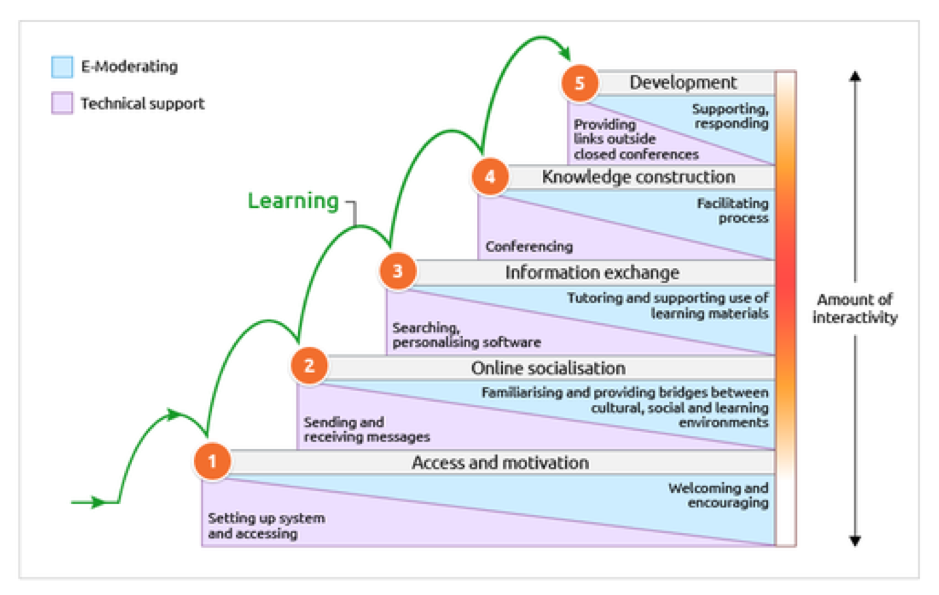
Image attribution: https://www.gillysalmon.com/five-stage-model.html
How do I do it?
The Five Stage Model provides a framework for instructors and designers in planning, building and evaluating learning designs and sequences of learning. It helps consider the activities, instructions, collaborative learning opportunities and the overall sequence of learning to ensure learners are successful.
Use the model to help design or evaluate your learning design at a high level by considering the sequence of activities and instructions, then at a lower level thinking about the specific instructions given, learning material and individual activities students will complete:
1. Access and motivation
Welcome your students – make them feel part of the community.
- Activity: Welcome announcement
- Activity: Icebreakers
2. Online socialisation
Introduction activities to help your students get to know each other and feel part of a community.
- Activity: Introductions Discussion Board.
- Activity: Provide students with opportunity to introduce themselves through Zoom. Ask why have they enrolled in the unit? What have they done in previous subjects? How does it relate to career/scholarly goals etc?
3. Information exchange
Begin to set tasks which require information/knowledge exchange among your students.
- Activity: Discussion Board – Ask students a thought provoking question or use a scenario to hear their response. Students then need to respond to at least 1 other student.
- Activity: Zoom – Undertake a jigsaw activity where students are sent into breakout rooms and assigned a topic to write a summary on. Students return to the main room and report back to the class.
4. Knowledge construction
Help to facilitate student discussions (synchronous or asynchronous) and to promote knowledge construction through social interaction and discourse.
- Activity: Small group discussions, problem-based learning, brainstorming, group presentations, peer feedback, reflection on learning etc.
5. Development
Your students will have more confidence to apply their knowledge to novel contexts. New knowledge can be applied to assessment tasks.
- Activity: Problem-based learning, team-based learning, authentic learning scenarios, role plays, small group discussion etc.
