
What is reflection?
In Democracy and Education , John Dewey (1916) articulated the distinction between events that are experienced and the subsequent processes that are employed to interrogate the nature of what has been experienced. There is a difference, in other words, between ‘the how’ of what has been experienced versus ‘the what’ that has been experienced. As Dewey (2016) says:
“…reflection upon experience gives rise to a distinction of what we experience (the experienced) and the experiencing – the how .” (pp 166-167).
This crucial distinction has subsequently been used as the basis for the development of reflective models of practice that have been widely applied in the area of teaching and learning.
Why is reflection important?
Reflection does not just happen. In the context of higher education, students need a reason to do it (constructive alignment between learning activities, materials and assessment) and therefore any reflective task needs to be designed. Students, therefore, need to be provided with scaffolds throughout the process but there also has to be a clear outcome related to the process of reflection. There are various models which can be used but Brookfield’s (1991) and Mezirow’s (1990) approaches emphasise the importance of the the goal of reflection – for Brookfield this represents the development of critical thinkers and for Mezirow, reflection is part of the process of making meaning through meaning schemas or, if this can’t be done, to redefine the problem at hand. These two quotes sum up these two approaches.
“To make ‘meaning’ means to make sense of an experience, we make an interpretation of it. When we subsequently use this interpretation to guide decision-making or action, then making ‘meaning’ becomes ‘learning’. We learn differently when we are learning to perform than when we are learning to understand what is being communicated to us. Reflection enables us to correct distortions in our beliefs and errors in problem-solving. Critical reflection involves a critique of the presuppositions on which our beliefs have been built. Learning may be defined as ‘the process of making a new or revised interpretation of the meaning of an experience, which guides subsequent understanding, appreciation and action’. ” (Mezirow, 1990, p.1)
“Thinking critically involves our recognising the assumptions underlying our beliefs and behaviours. It means we can give justifications for our ideas and actions” (Brookfield, 1991, p.13).
The move from reflective thinking to critical thinking is captured in the following image.
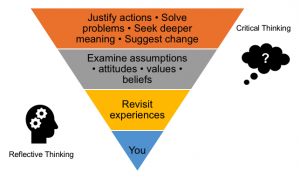
(From https://www.student.unsw.edu.au/reflective-writing)
Models of reflection
Three of the most prominent models of reflection are Gibbs’ reflective cycle (1988), Schon’s reflective practice (1983) and Kolb’s experiential cycle.
Gibb’s model for reflection
Gibb’s reflective cycle is outlined in this diagram.
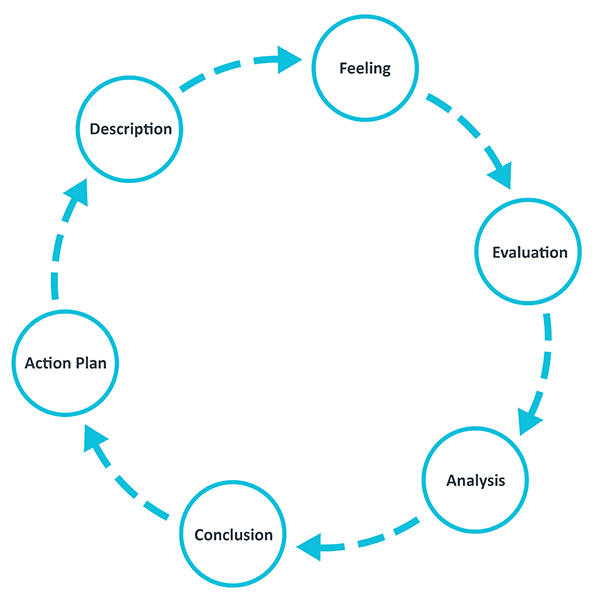
Ideas to help you design reflective learning activities based on this model are listed below.
|
Step 1: Description: what happened?
What, where and when did this happen? Step 2: Feelings: what were you thinking? What was your initial reaction, and what does this tell you? Did your feelings change? Step 3: Evaluation: What was good or bad about the experience? What went well? Step 4: Analysis: what sense can you make of the situation? What similarities or differences are there between this experience and other experiences? Step 5: Conclusion: what else could you have done? What are factors that affected the outcome? Step 6: Action plan: what will you do next time? If a similar situation/experience arose again, what would you do? |
Kolb’s model for reflection
Kolb’s cycle includes the following elements:
- Concrete experience . An individual or group task or even a community-based or work-integrated learning experience.
- Reflective observation . What has been done or performed? What were the individual’s or group’s experiences?
- Abstract conceptualisation . Interpretation of events.
- Active experimentation . How do you put what you have learned into practice? What will I do if the situation happens again?
The following table includes some ideas for the development of learning activities based on these phases.
| Concrete experience | Reflective observation | Abstract conceptualisation | Active experimentation |
|---|---|---|---|
|
|
|
|
Schon’s model for reflection
For Schon (1983), reflection is comprised of reflection-in action and reflection-on action. Reflection-in action occurs while the activity is taking place and reflection-on occurs after the event. The combination of these two modes of reflection is a way of improving practice because they help to develop a theory of practice in a particular domain. This can help students, for example, understand the gap between the application of theory in practice versus a theory of practice in a particular domain.
Reflection and teaching practice
The models of reflection that have been outlined can be applied to both student learning and professional practice. A well-known framework or perspective that is specifically associated with teaching practice has been developed by Stephen Brookfield (2002). Four critical reflective lenses are proposed: autobiographical, learners’ eyes, colleagues’ experiences and theoretical literature. Brookfield suggests that these four lenses can be used to promote the development of forms of critically reflective teaching practice.
References
Brookfield, S.D. (1991). Developing Critical Thinkers: Challenging Adults to Explore Alternative Ways of Thinking and Acting. San Francisco: Jossey-Bass
Brookfield, S.D. (2002), Using the lenses of critically reflective teaching in the community college classroom. New Directions for Community Colleges, 2002: 31-38. https://doi.org/10.1002/cc.61
Dewey, J. (1916). Democracy and Education: An Introduction to the Philosophy of Education . New York, The Free Press.
Gibbs, G. (1988) Learning by doing: A guide to teaching and learning methods. Oxford Further Education Unit, Oxford.
Kolb, D.A. Experiential Learning: Experience as the Source of Learning and Development (Englewood Cliffs, Prentice Hall, 1984)
Mezirow, J. (1990). How Critical Reflection triggers Transformative Learning Fostering Critical Reflection in Adulthood: A Guide to Transformative and Emancipatory learning (pp. 1-20). San Francisco, USA: Jossey-Bass.
Schon D. The Reflective Practitioner: How professionals think in action. London. Temple Smith; 1983
|
Dr Glenn Mason SFHEA is the Lead Learning Science Analyst at Western Sydney University and the editor of the university’s Online Engagement and Teaching Hub.
Please cite as Mason, G. (2024). Designing for reflection . Western Sydney University Online Engagement and Teaching Hub. https://lf.westernsydney.edu.au/engage/theory/designing-for-reflection |
