
Community of inquiry
This model was developed by Garrison et. al (1999) and it has become very influential as a framework for the development of online learning environments (Garrison et al., 2010). The model consists of three interrelated dimensions or ‘presences’: social presence, cognitive presence and teaching presence. The idea is that online learning environments require the existence of these presences to help facilitate learning that promotes critical inquiry. Although it was originally developed as a framework in the online learning space, it has also been used to support development practices in face-to-face (Warner, 2016) and hybrid modes (Zhang, 2020).
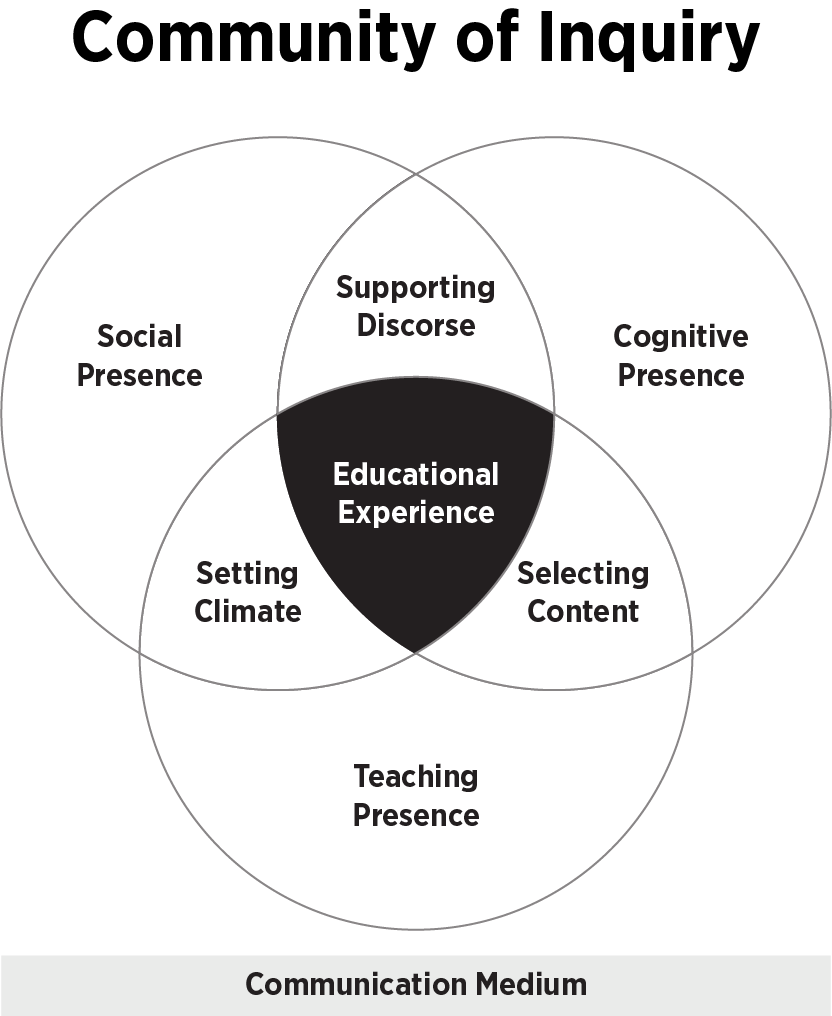
Image attribution: (Garrison et al., 1999)
Social presence refers to design elements that promote group cohesion and open and safe environments for conducting discourse.
Cognitive presence refers to elements within learning designs that promote cognitive engagement.
Teaching presence refers to learning design and teaching practice in the delivery of programs of study.
The Digital Learning Thresholds at Western Sydney University have been developed using this model. For more on how the model can be applied in the development of your learning environment go the following link. https://lf.westernsydney.edu.au/engage/technology/digital-learning-thresholds-building-your-foundations
Selected resources on the Community of Inquiry model
Fiock, H. (2020). Designing a community of inquiry in online courses. The International Review of Research in Open and Distributed Learning, 21 (1), 135-153.
This article provides guidance on using the Community of Inquiry framework, as well as providing a list of ideas that have emerged in previous research. The paper makes a significant contribution to the field because it aims to draw out the connections between the theoretical constructs of the model (the presences) and align them to practical learning activities that can be facilitated in a classroom setting. The paper is a good example of how the model can be used as a guide in authentic practice.
Garrison, D. R., Anderson, T., & Archer, W. (1999). Critical Inquiry in a Text-Based Environment: Computer Conferencing in Higher Education. The Internet and Higher Education, 2 (2–3), 87-105. doi: http://dx.doi.org/10.1016/S1096-7516(00)00016-6
This is the original paper on the Community of Inquiry framework that articulates and describes the three presences that are considered to be the foundations for rich learning experiences in online learning environments. The paper pre-dates some of the technologies that are currently part of the suite of tools that are used to facilitate online learning experiences and the insights in the paper are based on learning experiences in asynchronous environments. The framework, however, is applicable to all modes of delivery because it aims to provide the conditions of learning that is situated, practical and collaborative.
Garrison, D. R., Anderson, T., & Archer, W. (2010). The first decade of the community of inquiry framework: A retrospective. The internet and higher education, 13 (1-2), 5-9.
This article is a reflective piece by the originators of the Community of Inquiry framework, providing some historical background and commentary on developments from the first ten years of the concept. The paper is of value to those who are interested in work that explores the development of an instrument for measuring the presences in a Community of Inquiry and how instruments have been validated.
Karen, S., Garrison, D. R., & Jennifer, C. R. (2009). A Constructivist Approach to Online Learning: The Community of Inquiry Framework. In R. P. Carla (Ed.), Information Technology and Constructivism in Higher Education: Progressive Learning Frameworks (pp. 43-57). Hershey, PA, USA: IGI Global.
For those readers interested in the theoretical foundations of the Community of Inquiry model, this is a good place to start. The framework is positioned as an educational model that heavily borrows from the work of Dewey. Each of the presences is described using an aspect of Dewey’s ideas and expanded on to include how some of the design features relate to each of the components.
Kozan, K., & Caskurlu, S. (2018). On the Nth presence for the Community of Inquiry framework. Computers & Education , 122 , 104-118.
This article is a review of research into the Community of Inquiry framework, focusing on research that has sought to refine and/or expand the original three presences and on papers that have used the model as a theoretical foundation. The findings of the review suggest that care needs to be taken in thinking about adding extra dimensions to the framework since the parsimony of the model is seen as one of its benefits. Future research also needs to attend to the requirement for employing research methods that can ensure the validity and reliability of research findings.
Lee, S. M. (2014). The relationships between higher order thinking skills, cognitive density, and social presence in online learning. The internet and higher education , 21 , 41-52.
This paper investigates the correlation between cognitive presence and higher order thinking skills as well as the relationship between social and cognitive presence. The findings indicate that cognitive presence does not lead to the generation of higher order thinking skills although the authors did find that the quality of cognitive presence was positively associated with social presence. The paper is a good example of the work that is conducted to determine the association between the presences in the model.
Maddrell, J. A., Morrison, G. R., & Watson, G. S. (2017). Presence and learning in a community of inquiry. Distance Education, 38 (2), 245-258. doi: 10.1080/01587919.2017.1322062
The underlying assumption of the Community of Inquiry model suggests that the three presences are required to promote rich and meaningful learning experiences. Student perceptions of the model were recorded against learning achievement measures that were designed by instructors. The findings indicate that there was not a relationship between student perceptions and achievement measures which suggests that the underlying assumption of the framework is a contested space.
Warner, A. G. (2016). Developing a Community of Inquiry in a Face-to-Face Class: How an Online Learning Framework Can Enrich Traditional Classroom Practice. Journal of Management Education , 40 (4), 432–452. https://doi.org/10.1177/1052562916629515
The CoI model can also be used as a framework for face-to-face classes. This is a reflective piece written in the first person that is an account of how the model was used in a face-to-face postgraduate business program.
Zhang, R. (2020). Exploring blended learning experiences through the community of inquiry framework. Language Learning & Technology , 24 (1), 38–53.
The paper explores the Community of Inquiry model applied to a blended delivery of an English for Specific Purposes course. The findings indicate a correlation between the three presences. In particular, the results demonstrate that social presence was the key factor that influenced cognitive presence. The paper also discusses the use of the Community of Inquiry model as a learning design tool.
|
Dr Glenn Mason SFHEA is the Lead Learning Science Analyst at Western Sydney University and the editor of the university’s Online Engagement and Teaching Hub.
Please cite as Mason, G. (2024). Community of inquiry. Western Sydney University Online Engagement and Teaching Hub. https://lf.westernsydney.edu.au/engage/theory/community-of-inquiry |
