
What is it?
The term ‘learning design’ refers to the intentional design of learning events or sequences that are configured in such a way to help students meet the educational objectives of a unit of study or an individual lesson. The term is sometimes used interchangeably with ‘instructional design’, although ‘instructional design’ is more commonly used in a North American context and could be considered to have a slightly less student-centred flavour. Additionally, instructional design approaches are more commonly associated with models of training that date back to the middle part of the 20th century and are influenced by behaviourism. It is this idea of ‘designing for learning’ (Dalziel et. al, 2016) that is the key concept and it is helpful to view learning design as a practice rather than as a body of scholarly knowledge – it is an approach to learning that aims to create the conditions that promote learning and to encourage teachers to share their practice through learning design sequences or patterns that have been effective.
Below are some examples of approaches to learning design that can be adapted to suit your own contexts. Additionally, learning designs will need to be integrated into the curriculum and a spiral curriculum approach, for example, is likely to require different types of learning designs as students progress through the curriculum.
Conversational framework
One of the most prominent models of learning design is Laurillard’s ‘conversational framework’. The framework is based on high levels of interaction between teachers and students and it revolves around four ‘conversational’ phases:
- Discursive . This follows on from a knowledge acquisition stage and encourages a dialogic relationship between teachers and students to help students understand a concept or topic.
- Interactive . Through learning activities that incorporate the concepts that are being taught, students are provided with opportunities to interact with activities and tasks. Continuous feedback is provided throughout this phase.
- Adaptive . Students put ideas into practice and integrate and adapt their practice based on what they have learned.
- Reflective . Students reflect on the interactive and adaptive phases and consider how their future practice can be improved based on reflecting on these phases.
These phases are associated with six ‘learning types’ that are likely to be take place at various points in the conversational cycle:
- Acquisition . Students are presented with or engage with material and will be required to be able to demonstrate the ability to remember, list or define key concepts or information.
- Inquiry or investigation . This refers to an exploratory, self-directed phase of learning which encourages students to do something with their acquired knowledge – this may be answering a question or analysing a case study or set of examples.
- Discussion . Students share knowledge and and evaluate and analyse different perspectives.
- Practice . Students put what they have learned into practice. This is an iterative cycle of application of knowledge, feedback (from peers or teachers), reflection and revision of practice. Practice could be in the form of the development of practical skills or essay-style assessment tasks.
- Production . Students apply their knowledge in practice and create an artefact such as a plan, design or a performative piece that can be evaluated.
- Collaboration . This refers to social learning practices that require skills in negotiation, taking in different perspectives and the construction of knowledge based on group discussions and collaborative activity.
For more see https://fetliu.net/blog/designing-your-teaching-sessions-using-laurillards-learning-types/
How can you apply the conversational framework for online or blended learning? See this article for more – https://fetliu.net/blog/laurillards-learning-types-for-online-and-blended-learning/
Explore, design and apply
Learning designs are often associated with visual representation of phases and learning events. This also means that they can be treated as artefacts that can be shared and applied in different contexts. One example is the ‘explore, design and apply’ design. In this design, learning materials are represented by blue triangles, student learning by green rectangles and discursive and other forms of support by the orange circles.
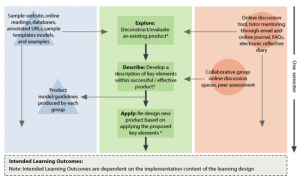
From http://www.learningdesigns.uow.edu.au/guides/info/G4/more/02Context.htm
An example of this learning design for a Business-based assessment is adapted from http://www.learningdesigns.uow.edu.au/guides/info/G4/more/02Context.htm .
- Objective : The course is learning how to develop marketing plans. The students assume a role in a company looking to develop an innovative startup company.
- Explore : For the first task, a proposal in the form of an existing marketing plan is presented and students are required to provide a report on it. The plan will have some known weaknesses and the intention is for students to discover and describe what these might be. The outcome could be a report to a superior.
- Design : In the second task, students are given a task to develop some guidelines and strategies that will result in a successful marketing plan in that organization for the startup. The development of the guidelines needs to be given in some meaningful context.
- Apply : Finally the student is given the task of developing a final marketing plan. The task is scaffolded by the guidelines and strategies developed in task 2 and the student works with others to apply this information in a creative and applied fashion. The setting provides many supports in this final task including templates, advice from senior staff, cases etc.
Additionally, all learning designs implemented in learning environments need to consider the following wider design, assessment and pedagogical considerations:
- Constructive alignment
- Active and student-centred learning
- Online learning environments – key considerations
Resources
This resource includes a whole range of learning design frameworks and approaches – https://padlet.com/hefi1/ulvzhubn02o8kmru?utm_source=sendgrid.com&utm_medium=email&utm_campaign=website
References
Dalziel, J., Conole, G., Wills, S., Walker, S., Bennett, S., Dobozy, E., Cameron, L., Badilescu-Buga, E. and Bower, M., 2016. The Larnaca Declaration on Learning Design. Journal of Interactive Media in Education , 2016(1), p.7. DOI: http://doi.org/10.5334/jime.407
