
Feedback Strategies
What are they?
According to Carless and Boud (2018), effective feedback requires a shift from learners being conceptualised as passive recipients of feedback to learners who possess the skills to process and integrate feedback. This requires a shift in feedback design from the provision of one-off pieces of feedback to the design of feedback as part of the learning process. This requires the development of feedback literacy on the part of students and the capacity for teaching staff to modify their feedback practices.
How do I do it?
Strategies to develop student feedback literacy
Student feedback literacy (Carless and Boud, 2018) requires requires consideration of the following:
| Consideration | Description |
| Appreciation of the feedback process by students | This refers to the recognition of the value of feedback and its role in the learning process. |
| The development of judgement by students | To leverage feedback processes, it is important for students to develop skills in the evaluation of their own work and in their peers. |
| The management of affect by students and teachers | Feedback can have the potential to have negative effects on student learning at the level of affect. Student dispositions towards engagement with feedback are often under-developed but it is important to develop a trusting and safe relationship with students to help them develop a positive attitude towards in the integration of feedback in the learning process. |
| Taking action based on feedback | This is an essential part of the feedback process. Students need to take action on feedback to close the ‘feedback loop’ and to use feedback to help share future learning. |
Designing feedback strategies
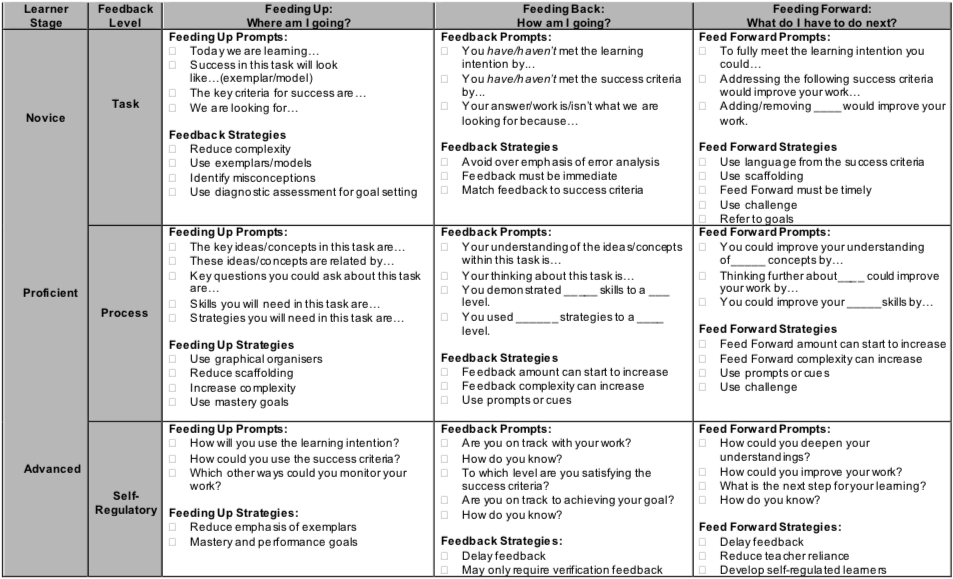
According to the model of feedback developed by Hattie and Timperley (2007), effective feedback needs to address three questions:
| Question | Type of feedback |
| Where am I going? (goals) | Feed up |
| How am I going? | Feed back |
| Where do I go next? | Feed forward |
The model requires each of these questions to be addressed at four levels:
- How well students understand or perform the required task (task level)
- The processes and strategies that are needed to understand or perform the task (process)
- The level of self-regulation that is required to perform or understand the task (self-regulation level)
- The way in which feedback and evaluation impacts the student’s sense of self (affect level)
This model has been used as the basis for the following feedback for learning (Brooks et. al, 2019) matrix.
References
Brooks, C., Carroll, A., Gillies, R. M., & Hattie, J. (2019). A Matrix of Feedback for Learning. Australian Journal of Teacher Education, 44(4).
http://dx.doi.org/10.14221/ajte.2018v44n4.2
Carless, D., & Boud, D. (2018). The development of student feedback literacy: Enabling uptake of feedback. Assessment & Evaluation in Higher Education , 43 (8), 1315–1325. https://doi.org/10.1080/02602938.2018.1463354
Hattie, J., & Timperley, H. (2007). The Power of Feedback. Review of Educational Research, (77, 1). Sage Publications, Sage CA: Thousand Oaks, CA. https://doi.org/10.3102/003465430298487
Molloy, E. and Boud, D. (2013). Feedback models for learning, teaching and performance. In Spector, J. M., Merrill, D., Elen, J. and Bishop, M.J. (Eds.) Handbook of Research on Educational Communications and Technology. Fourth Edition. Springer: New York, 413-424. DOI 10.1007/978-1-4614-3185-5_33
