
What is it?
Jigsaw is a cooperative learning activity that can be used to develop skills and expertise for effective group-based learning. It focuses on the development of listening, speaking, collaboration, reflection, and problem-solving skills. It can also be used to develop students’ teaching skills.
Jigsaw does require some pre-class preparation and students will need explicit instructions to understand the requirements of the activity.
Why use it?
To help structure and design opportunities for student-centred discussions.
The activity is useful to help build background knowledge in a unit of study and to assist students to learn about and consider different perspectives related to an event or theory. It can also be helpful in reviewing different aspects of a unit of study and to help students prepare for an assessment.
How do I do it?
- Put students into groups of four. These groups will be the “home groups” of the jigsaw. Prepare and divide the content into segments based on the home group numbers. For example, if there are six pieces of content, then each group should have six members.
- Prepare a direction sheet with a learning goal to help students answer questions and gather information on each segment or selection.
- Divide the class into their home groups. Each student is now reading or engaging with the piece of content they have been assigned.

- Students will now leave their home group to sit with a group of students assigned to the same reading segment or selection i.e. their ‘expert’ group. Ask students to begin reading to themselves, or have them take turns reading aloud. When students are finished reading, the group should discuss their segment, fill out their direction sheet, and decide what and how they should present to their home groups.
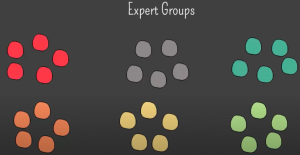
- Students regroup with their home groups.
- Each student is responsible for teaching their reading segment or selection to their home group. All students are responsible for learning all material. Determine how you would like students to organise and summarise all the information that they have learned.
Considerations
- Timing can be challenging and a timer can be helpful to keep things on track.
- Visit each group to gauge their understanding of the topic.
- Try a flipped approach and ask students to carry out some research or reading before commencing the activity in your face-to-face session.
- Group students by letting them pick numbered or coloured pieces of paper to represent the different groups.
- During group sessions, students may require some direction direction or clarification of concepts within their segment. Encourage group leaders to manage the group by ensuring that group members stay on task.
- At the end of the session, give students a group quiz on the segments or content to add a gaming element to this activity.
-
The following tools and technologies may be useful:
- vUWS Group tool
- Google Docs
- Zoom for online synchronous sessions
Resources
For more on the jigsaw approach and its application in addressing social issues – https://www.jigsaw.org/
